How long is the Addiction to Alcohol? Everyone has their own number of days, weeks and months. Some individuals can become alcoholics over a period of time while others may become a serious problem rather quickly. The risk varies based on the amount, frequency, rate, genetics, mental health and other factors of the person.
Alcohol use disorder (AUD) is a medical condition that affects a person’s control over their drinking of alcohol, despite the negative consequences. It can range from mild to severe. Knowing the early warning signs is important in order to not suffer long-term damage from drinking.
Key Takeaways
- The onset of alcoholism is not predictable.
- The higher your level of drinking, and the more often you drink, the more likely you are to develop an alcohol use disorder.
- Binge drinking poses a risk even to those who don’t drink every day.
- Warning signs consist of tolerance, cravings, overindulgence and an inability to stop drinking.
- Vulnerability can be raised by family history, the stress of the world, trauma and mental health issues.
- But alcohol abuse does not necessarily mean dependency, and behaviors vary from time to time.
- People can benefit from professional assistance to decrease drinking, safely quit drinking, and establish long-term recovery.
- Alcohol can be a dangerous drug if someone has been drinking to excess for a prolonged period of time, they may experience dangerous alcohol withdrawal symptoms if they suddenly stop drinking alcohol, which should be discussed with a health care professional.
So, How Long Does It Take To Become Addicted To Alcohol? The best answer is it depends on the individual. There are no drinking patterns that have been found that can predict when a person will become addicted.
Early Signs of Alcohol Dependence
Initial signs of addiction to alcohol may be hard to detect. An individual may be working, in school, have relationships, and appear to have control of his/her life. But there are important clues to look at in drinking behaviors.
Some of the early warning signs are:
- Increasing alcohol consumption beyond what was planned for consumption.
- The constant desire to drink alcohol.Frequent thinking about alcohol.
- Feeling strong cravings
- In order to get the same effect, more will be needed.
- Using alcohol to relax, to fall asleep, as a way of coping, or to feel good from it
- A reduction in drinking but continued cycling at the old drinking pattern.
- Increasing the time spent in obtaining alcohol, drinking alcohol and/or recovering from alcohol consumption
People with these signs do not necessarily have to be alcoholics. Consider getting a professional assessment to help you decide whether there’s a problem with drinking.
How Alcohol Use Can Progress Over Time
Alcohol addiction usually occurs due to repeated drinking, changes in brain function, acquired behaviours and the risk factors.
Others may begin to drink socially. Eventually, alcohol consumption can turn into a habit to alleviate stress or tough emotions. A person can also get used to the effects, and require more alcohol for a given effect.
The order is not necessarily chronological. Others binge for a while and then taper. Some people suffer from severe issues after years of moderate drinking.
The National Institute on Alcohol Abuse and Alcoholism (NIAAA) research indicates that risk relates to the amount of alcohol consumed, how much and often, how fast it’s consumed and genetic, environmental and mental health factors.
There’s no definitive timeline for How Long Does It Take To Become Addicted To Alcohol? since it varies from person to person, depending on their body type, their genetic susceptibility, and a variety of other factors.
Risk Factors That Increase the Chance of Alcohol Addiction
Some things increase the risk of alcoholism.
Family History
Alcohol use disorder susceptibility can vary from person to person, depending on genetics. Studies have shown that there is an increased risk of alcoholism if a close family member has also had a drinking problem – though this is not always the case.
Drinking at a Young Age
Starting to drink during adolescence is associated with a greater risk of developing alcohol-related problems later in life.
Frequent or Heavy Drinking
The higher the amount of alcohol consumed and the more often it’s consumed the more potential risk there is.
Mental Health Concerns
Depression, anxiety, post-traumatic stress and other mental health problems may also occur with alcohol use disorder. Some people may resort to alcohol to dull down the bad feelings, which can lead to overuse of alcohol.
Trauma and Chronic Stress
You may be more susceptible if you are stressed out, or have suffered a trauma, particularly if you are using alcohol to cope with stress.
Social Environment
High stress drinking or low levels of support can make unhealthy drinking easier.
Can You Become Addicted to Alcohol After Drinking Occasionally?
Alcohol use can become addictive, but it is not for everyone who drinks alcohol.
Frequency of drinking isn’t the only factor. It is the combination of alcohol and them.
For instance, if somebody drinks sometimes, they might start consuming more when they are in social settings. Another person may just drink on the weekends, but gradually develop a habit of drinking to sleep or to relax.
If you’re wondering How Long Does It Take To Become Addicted To Alcohol? you should consider the weeks that have passed since you had your first drink rather than how many days.
- Am I able to easily avoid drinking alcohol?
- Am I drinking too much?
- I am feeling like eating or drinking?
- Have I tried to limit my drinking?
- If I consume more alcohol will I feel the same?
- Have there been problems in my life which are connected to my drinking?
Specific time series might not provide answers that are helpful.
How Much Alcohol Increases the Risk of Addiction?
No amount is safe to ensure addiction does not take place. Eating more, drinking more frequently and binge drinking can, however, increase the risk.
NIAAA considers binge drinking to be a pattern in the United States that usually leads to a blood alcohol concentration of 0.08% or more. It’s the same as four or more drinks in two hours or less for a regular adult or five or more drinks for men in two hours or less.
Heavy drinking, according to NIAAA is defined as:
- Men: Four or more drinks in a day or five or more per week
- Women: Three or more drinks on any day or 10 or more per week
A standard drink is approximately 12 ounces of a regular beer, 5 ounces of a glass of wine or 1.5 ounces of 80 proof distilled spirits. Be sure to count larger/stronger drinks as more than one drink.
Numbers are guidelines to risk and are not a definition of addiction.
When Does Drinking Become a Problem?
If drinking alcohol begins to have a negative impact on an individual’s health, responsibilities, relationships, safety or behaviour, then it is a concern.
It is possible to have a problem even if you don’t drink every day.
If you do any of the following, you may have a drinking problem:
- Regularly drinks more than intended
- Frequently experiences blackouts
- Lacks is absent or fails to perform at work or school because of alcohol abuse or addiction.Lacks’ alcohol abuse or addiction results in absenteeism or poor performance at work or school.
- Drives after drinking
- Has problems with other people about drinking
- Uses alcohol to deal with challenging emotions
- The lack made it to take a break from drinking without any issues whatsoever
- Takes behavior or interest away when the use of the item is not continued
Often is not the only question to ask when you’re trying to quit. Also, ask yourself, “What is the importance of alcohol in my life?”
If the drinking is beginning to cause problems, it may be time to get some assistance.
Need Help With Alcohol Use?
It’s not necessary to wait until there is a big problem when you start to drink. Your professional people are here to help you understand what’s going on in your life, and what you can do next if your drinking is negatively impacting your relationships, responsibilities, mood or daily activities.
WellMind Therapy Center is here to help you understand your alcohol use, explore the potential causes of using alcohol and provide you with a unique path towards recovery. Please contact us and we will see how we can help you!
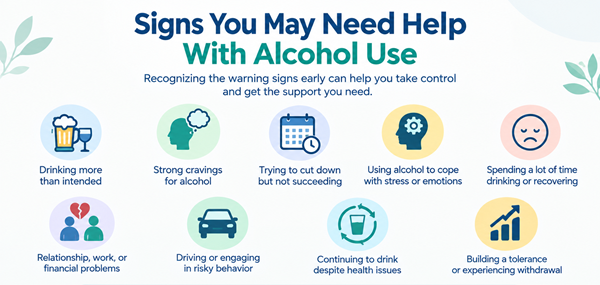
Signs You May Need Help With Alcohol Use
If you are seeing some of these symptoms, it is important to discuss it with a professional:
- Drink longer and/or more than you intended.
- You have been making an effort to cut down on some items, but not yet.
- Have a strong desire to drink.
- Consume/attempt to drink a significant amount of time.
- Alcohol interferes with work, school, family or other responsibilities.
- You continue to drink alcohol even if there are relationship problems.
- You begin to put down activities in exchange for drinking.
- You are at a higher risk of being injured when you drink.
- Even when your body or mind are telling you to stop, you keep on drinking.
- You get used to or rely on the drug.
These symptoms are one of the clinical criteria which are used to assess Alcohol Use Disorder. AUD is considered mild, moderate or severe depending on the number and severity of symptoms.
How Treatment Can Help With Alcohol Addiction
One individual is not like the next and all must have to face their own. Alcohol addiction treatment is customized to an individual’s drinking history, health, mental health, objectives and support network.
Care may consist of:
Assessment and Planning
A professional will be able to tell if there is a problem with alcohol, alcohol withdrawal, mental health, physical health, medications and other issues.
Behavioral Support
Persons can be taught about triggers, breaking unhelpful cycles, coping with craving and new ways of coping through counselling and behavioural strategies.
Medication
Some medications are FDA-approved that can assist some people to lessen their drinking, deal with cravings, or recuperate. Naltrexone, acamprosate, and disulfiram are typical drugs used for alcohol use disorder. Medication can only be determined by a health care worker.
Recovery Support
The recovery process can be lengthy and can involve counselling, peer support, family support, lifestyle changes and ongoing professional recovery services.
Alcohol withdrawal may be more serious in someone who has been excessively drinking alcohol for a long period of time, and can be dangerous if the person suddenly stops drinking. Medical advice may be needed for withdrawal.
But it’s not all about So How Long Does It Take To Become Addicted To Alcohol?; it’s about whether today, control of alcohol is becoming more difficult.
Can Alcohol Addiction Be Prevented?
While it is not always possible to prevent alcohol addiction, there are ways to minimise risks.
Helpful steps include:
- Avoid binge drinking.
- Keep track of how much alcohol you consume.
- Avoid drinking for a day or days (as appropriate) without alcohol use.
- Don’t rely on alcohol to relieve stress.
- If it is getting out of hand, discuss it with a person.
- Do not hesitate to reach out to a professional for help, if stressed or depressed, or if experiencing trauma or other problems.
- Know your family history and risk factors.
- Don’t wait for serious consequences, seek early help.
People that can’t control how much they drink may be better off abstaining.
How is Alcohol Addiction Treated?
It is possible to overcome addiction to alcohol. This can be in addition to or in combination with behavioral therapies, medications, and/or recovery support.
Treatment plans should be individual to the person, and may change as the individual recovers, SAMHSA notes. For many people with SUD, there is evidence that supports their use of behavioral therapies, medications, and recovery supports.
Treatment can be aimed at any of the following:
- Identifying triggers
- Managing cravings
- Develop healthy coping strategies.
- Improving relationships
- Addressing the mental health problems associated with co-occurrence
- Preventing relapse
- Development of a sustainable recovery plan.
You don’t need to start on the right foot. This may begin by simply talking about the effect of alcohol on a person’s life.
Take the Next Step With WellMind Therapy Center
You don’t have to go it alone if you are asking yourself How Long Does It Take To Become Addicted To Alcohol? when it comes to you or someone you love getting drunk.
Call WellMind Therapy Center today to find out more about alcohol use support options. Discussing the problem with a licensed professional will enable you to understand what you can do and what you need to do next.
Frequently Asked Questions
How long does it take to develop alcohol dependence?
The timeline for alcohol dependence is not defined. It can take months or years to develop, and some people are more susceptible and can be affected more quickly if they drink excessively or binge. Risk is influenced by drinking pattern, genetic, health and other factors.
How many drinks a day is considered alcoholism?
No set number of drinks means alcoholism. But, drinking regularly and heavily or binge increases the risk. According to NIAAA, men are considered to be heavy drinkers if they consume five or more drinks per day, and women are heavy drinkers if they consume four or more drinks per day.
What are 5 warning signs of addiction?
The five warning signs are drinking more than intended, unsuccessful attempts to reduce drinking, strong cravings, continuing to drink despite problems, and tolerance/withdrawal. These symptoms are indication for a professional evaluation for alcohol use disorders.
What does 7 days no alcohol do to your body?
Some people feel better sleep, hydrated, happier and more energized after 7 days of no alcohol, but this varies from person to person. The benefits vary with past drinking history, health status and presence of withdrawal symptoms.
How long until alcohol is 100% out of your system?
It is not a fixed length of time, as everyone’s body and situation is different when it comes to alcohol consumption. Body size, food, amount of fluids consumed, liver function and other factors are important. If you feel sober, it doesn’t mean the alcohol has left your body.
Can Alcohol Addiction Be Prevented?
Drinking in moderation, avoiding binge drinking, avoiding excessive exposure to alcohol, early intervention for mental health and stress management issues, and seeking help when difficulties with drinking arise can help reduce risk. Those who are at higher risk may be better off not drinking any alcohol.
How Is Alcohol Addiction Treated?
There is behavioral support, medication, recovery programmes and continuous professional care in treating alcohol addiction. Treatment is tailored to individual drinking behaviors, health and mental health concerns, treatment goals, and the need for support.
Final Thoughts
So, How Long Does It Take To Become Addicted To Alcohol? There is no universal answer. Alcohol addiction is influenced by drinking frequency, amount, speed of consumption, genetics, mental health, environment, and other personal factors.
What matters most is recognizing changes in your relationship with alcohol.
If drinking is becoming harder to control, you are experiencing cravings, or alcohol is causing problems in your life, help is available. Early support can make it easier to address unhealthy patterns before they become more difficult to change.
WellMind Therapy Center is here to help you explore your concerns, understand your options, and take a practical step toward recovery. Reach out today to learn more.
Disclaimer
This blog is provided for general educational and informational purposes only. It is not a substitute for professional medical, psychiatric, psychological, or emergency care. Alcohol withdrawal can sometimes be life-threatening, particularly after prolonged heavy drinking. Do not stop heavy alcohol use suddenly without discussing your situation with a qualified healthcare professional. If you or someone else is experiencing an alcohol-related emergency, seek immediate emergency medical assistance.
References
1. National Institute on Alcohol Abuse and Alcoholism (NIAAA) – Understanding Alcohol Use Disorder https://www.niaaa.nih.gov/publications/brochures-and-fact-sheets/understanding-alcohol-use-disorder Explains alcohol use disorder, risk factors, symptoms, and available support.
2. MedlinePlus – Alcohol Use Disorder https://medlineplus.gov/alcoholusedisorderaud.html Covers warning signs, contributing factors, and the effects of problematic alcohol use.
3. NIAAA – The Cycle of Alcohol Addiction https://www.niaaa.nih.gov/publications/cycle-alcohol-addiction Explains how repeated alcohol use can contribute to changes in the brain and compulsive drinking patterns.
4. NIAAA – Alcohol and the Brain: An Overview https://www.niaaa.nih.gov/publications/alcohol-and-brain-overview Describes alcohol’s effects on brain function and how repeated use can increase the risk of alcohol use disorder.
5. NIAAA – Alcohol Use Disorder: From Risk to Diagnosis to Recovery https://www.niaaa.nih.gov/health-professionals-communities/core-resource-on-alcohol/alcohol-use-disorder-risk-diagnosis-recovery Provides information about risk factors, diagnostic symptoms, and recovery options.